
Walk the halls of Trinity Catholic Middle School in Fort Smith, Arkansas on any given Wednesday and you might notice something unexpected: students arriving early. Not for sports practice or a club meeting, but to check on their 3D prints.
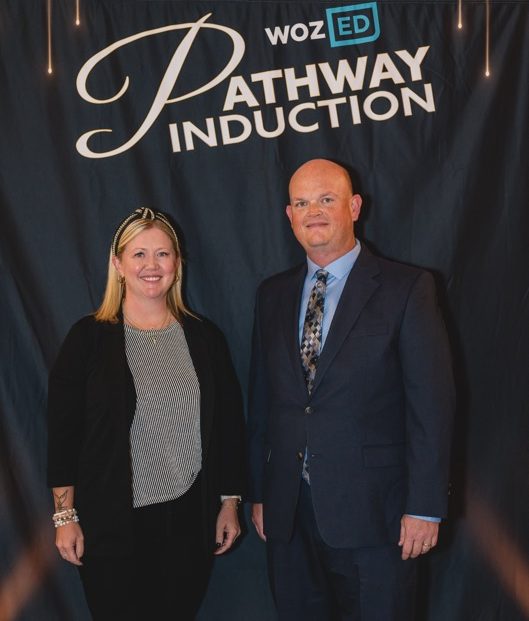
That kind of self-motivated engagement is exactly what Principal Zach Edwards and Assistant Principal Brandy Rinke set out to create when they began scaling Trinity’s STEM program. After years of laying groundwork, their partnership with Woz ED this past year has helped turn that vision into a full-blown program, one that’s now serving many students across grades 6–8, with demand continuing to outpace capacity.
A Program Built on Student Demand
Trinity’s STEM journey didn’t happen overnight. The school began integrating STEM activities about five to six years ago, with a more concentrated focus developing over the past two years. The Woz ED partnership, established this past school year, marked a turning point that brought structure, comprehensive kits, and curriculum that teachers could implement confidently without the need to be experts.
Today, the program spans multiple course offerings including: An after-school robotics club, a sixth grade career exploration course, Drone and Animation electives for seventh and eighth graders, and an eight grade art class that includes lessons in Engineering and 3D Printing.
What speaks the loudest here is student interest. Midway through the first semester, seventh graders who hadn’t initially signed up for STEM electives were asking for additional sections after hearing their peers talk about the experience. By course registration for next year, all incoming eighth graders had selected STEM electives.
“Students who didn’t sign up were disappointed they missed out,” Zach noted. “That’s when you know something is working.”
Leveling the Playing Field
For Zach, who has spent 17 years at Trinity and the last four as principal, the STEM program represents something beyond academics. It’s about expanding the definition of what it means to succeed at school.
“Not every student is an athlete. Not every student thrives in a traditional classroom setting,” he explained. “I want to create opportunities where different kinds of learners can excel, lead, and feel proud of what they’re doing.”
That vision is playing out in real time. Students who have historically struggled academically are stepping up as leaders in hands-on STEM projects. In the sixth grade careers class, a group of girls has been meticulously documenting every step of mini-Sphero mapping: testing configurations, recording results, and integrating. The catch is that no one asked them to do it; they just did.
Brandy, who came to her role as assistant principal after years as a media specialist, sees this as the natural outcome of project-based learning done right. Her guiding belief: “Learning is loud.”
“When students are genuinely engaged, you hear it,” she said. “The classroom is buzzing. They’re talking, problem-solving, figuring things out together. That’s what we want.”
Teachers as Co-Learners
One common barrier to STEM adoption in schools is teacher confidence. Many educators worry they need deep technical expertise before they can facilitate these courses. At Trinity, Brandy has deliberately worked to reframe that expectation.
“Teachers don’t need to be the expert in the room,” she emphasized. “Woz ED makes that possible. The kits have everything organized and labeled. The instructions are detailed enough that teachers can genuinely learn alongside their students, and that’s actually a powerful model for kids to see.”
This approach has lowered the barrier for cross-curricular integration as well. The 3D printing and engineering curriculum, for example, is being delivered through an eighth grade art class, a natural fit that has students thinking about design, form, and function simultaneously.
What’s Coming Next
The momentum at Trinity shows no signs of slowing. Looking ahead to next school year, the leadership team has already confirmed several major milestones. A new cybersecurity course is launching and the kit has already been purchased. A dedicated STEM center is under renovation, transforming former dorm rooms into a hub with breakout spaces and STEM-themed decor. Administrators also plan to expand elective sections in response to enrollment demand.
For Zach and Brandy, the physical STEM center represents something symbolic as much as practical. It stands as a dedicated space that signals to students, families, and staff that STEM is a cornerstone of the Trinity experience, not an afterthought. The Trinity team is motivated by student excitement. As Principal Edwards says, “When you see a student arrive early just to check on their 3D print, you know the program has taken root. That’s intrinsic motivation — and that’s what we’re building toward.”
