What happens when a school community commits to hands-on, pathway-based learning from kindergarten through ninth grade? At Vermilion Charter Academy in rural Louisiana, two educators are finding out and the answer involves Cubelets, stop-motion, and a whole lot of trying and trying again.
Creating a School-Wide Web of STEM Instruction
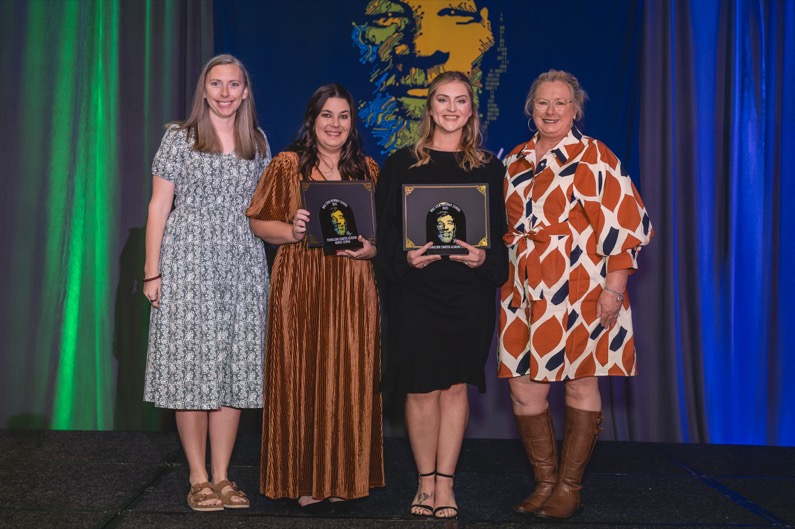
Now in her second year as a STEM specialist, Vermilion Charter elementary’s dedicated STEM teacher, Chelsea Baudoin, has been a part of an incredible rotation model that allows her to reach every student from kindergarten through fifth grade. Each class spends three weeks in her room, moving from introduction to practice to real-world application before cycling back to their homeroom.
The framework is deliberate. Week one is for exploration and watching examples. Week two is guided practice with templates. Week three is the payoff- when students apply what they’ve learned to other subject material like history, art, and math. It’s a model designed for engagement and application.
This year she piloted three Woz ED Pathways: Robotics, Cybersecurity, and Stop Motion Animation. Kindergarteners used Cubelets to investigate the five senses, making connections between robotic sensors and nature. Third through fifth graders coded Spheros across classroom floors to explore area, perimeter, and coordinate systems. Fourth graders built maze projects calibrated to protractor measurements from their current math unit. Meanwhile, first graders used the stop motion kit to document a live caterpillar’s lifecycle from egg to cocoon to butterfly frame by frame, in sync with what was happening in their own classroom terrarium.
Baudoin speaks of using Woz ED resources and says,
“When students have access to different learning tools, they build important problem-solving skills that prepare them for life beyond the classroom.”
The work surfaces real challenges, too. When fourth graders lack foundational knowledge of angles and degrees, grade-level robotics projects lose their meaning. They become exercises in copying code rather than understanding it. She’s been candid about this, advocating for smaller class sizes and, in year three, a plan to train homeroom teachers to facilitate STEM kit activities independently. The goal at the elementary level is to extend pathways into regular instruction hours so that students have more exposure at early learning levels.
Building A Program From The Ground Up
Across the way, Tori Robin is navigating a different kind of challenge. She joined Vermilion Charter’s brand-new middle school, after eight years teaching high school business. The newly opened school serves grades 6–9 with roughly 450 students. Next year it will expand to grade 11 and there is a high school building under construction next door.
Tori teaches three distinct courses: a 9-week exploratory rotation for sixth graders, a full-year computer science course for seventh grade, and a 8th/9th grade exploratory course designed to help students identify interests before high school,. The base curriculum comes from LSU, while Woz ED kits provide the hands-on layer.
The Digital Design and Animation kit has been the clear standout. Students built Lego creations, photographed them frame by frame, and assembled stop-motion videos — an experience that blends creativity, patience, and iteration in ways an iPad alone simply can’t. Students who weren’t initially invested were entirely engaged. Sixth graders from a previous rotation have asked to attend STEM again, which speaks to their interest in the material.
Tori has noticed a handful of outcomes when it comes to the new STEM Curriculum: Students recognize the kit boxes stored under tables and visibly light up when they appear, collaborative work creates buy-in that tablets and textbooks no longer deliver on their own, mistakes become teachable moments students acknowledge themselves, and middle schoolers get to play–an experience which is crucial for basic development.
Tori’s year-two goal is to integrate STEM kits into lessons that don’t naturally land with students in hopes to increase engagement and retention. She attended the Woz ED Pathway Conference in Arizona in November alongside a colleague, where she had an “exceptional experience.” She was excited to share video footage of the Waymo self-driving car she rode in with her students.
Partners Make a Difference
Both Robin and Baudoin credit their partnership with PowerUp EDU as a major contributor to the creation of the STEM program at Vermilion Charter Academy. It was the PowerUp team that pointed them in the direction of Woz ED kits and helped them build a well rounded curriculum. When you’re building a program, the more people you have in your corner, the better!
A Shared Vision in STEM Learning
What connects these two educators across grade levels and campuses is a shared conviction: that learning to try, fail, and try again matters more than any single educational standard. At the elementary level, that means teaching foundational knowledge of the engineering design process. At the middle school, it means giving students the experience of working together to build something from scratch.
For year three, the elementary campus plans to implement two pathways per grade level, nearly tripling active kit usage, while building a distributed facilitation model so more teachers can teach STEM concepts. At the middle school, Tori is weaving kits more deeply into the curriculum she now knows well, shaping the kind of STEM program that a brand-new school gets to define from scratch.
